Lynx
- 182
- Global rank
- 182
- Month rank
- 173
- Week rank
Lynx is a double extortion ransomware: attackers encrypt important and sensitive data and demand a ransom for decryption simultaneously threatening to publish or sell the data. Active since mid-2024. Among techniques are terminating processes and services, privilege escalation, deleting shadow copies. Distribution by phishing, malvertising, exploiting vulnerabilities.
- Ransomware
- Type
- Unknown
- Origin
- 29 July, 2024
- First seen
- 18 September, 2026
- Last seen
How to analyze Lynx with ANY.RUN
IOCs
IP addresses
- 95.100.102.9
- 172.211.123.249
- 23.216.77.24
- 135.233.95.144
- 40.126.32.74
- 48.192.1.64
- 40.126.31.67
- 57.153.246.3
- 23.11.41.157
- 135.233.95.135
- 23.194.190.165
- 48.209.138.168
- 23.59.18.102
- 2.16.241.201
- 204.79.197.203
- 172.211.123.250
- 20.190.159.23
- 48.192.1.65
- 48.209.6.48
- 23.195.250.165
Hashes
- 8990ae8c5d6bdc7dd63162d50eb8f2789957a4aa72d908e6107f36d7b1486441
- a0170bddb45f13158a7334ddacff649c3d02a981a639380cd93548658f687098
- 2b61e0faa9f5b8cbf08782eccbd25c3d17b113b50bbb2e7ade2182a0950824c5
- c116652c617d8f5621c4bb5ba51fe17efd54b51d08a76bb99edbfe1349772983
- cdf17e077045afba31a4e90c5655ba34367a1bacdb8fca5154eebff706a98759
- b75fdee208d2834ab147dacb51f4e7d70e44457c8b639048fe67b252b8d61f1f
- 91b7b07091ce67ec235f3db2d7ae8a8aaa42b952e2de0a228659f4813de3e3d4
- ef01b2342b49597ad0e326cad64ab471ec4460e09fe66a90e75bc30bf209cfc8
- fee77297d45ae6e0732a814966dff13c86c460c118cf6173e85f558ca8ee35fd
- ef3aea36fbaf20c0b93b20d023c649b75adb6444e1470ad45d2834374d6f5df8
- 3a2d6b7a8671d090de7fa3be8036ea7a3c214b964bda0acfafdd3f73779bb5be
- a7a155934662984a5063d8d9215dc5e226aa12f4e04fca932574ea075e32dd3a
- 267e3f3f4fa5201f980063b289a6140423480b8ba9d6361b5d06a76af709d011
- 0d6b63ab2cf10c9b55eabc046580fcbf36c85f9459d3c2316493315674aadc72
- de41e1e2376eeebdc2064d8652f0caed33a535f9c688a9539cb18f2ddb2af47f
- 568cc8c191d2e1653250d5d7aa36ed867e08fce807fdcd974ecf409e268f71d8
- 59892c3d27b1032ad6d79254d1f836c76c4e508ce3779401067fb98502fcfc8c
- 912e980d8d0ae59709609e5577c33ba4657db5dfe3e8a4391c772f4c194c56e7
- 4fbbf0d94f1140ffde0bdd48c5b07f91f2292fae78b227e48a50b60ed624763b
- c47e261aaee18f3fff252565b86b9ef8a9256142358470ec686d103f6a3b6a8b
Domains
- nexusrules.officeapps.live.com
- settings-win.data.microsoft.com
- www.microsoft.com
- slscr.update.microsoft.com
- google.com
- ecs.office.com
- fe3cr.delivery.mp.microsoft.com
- crl.microsoft.com
- go.microsoft.com
- login.live.com
- www.bing.com
- activation-v2.sls.microsoft.com
- self.events.data.microsoft.com
- ocsp.digicert.com
- client.wns.windows.com
- oneocsp.microsoft.com
- officeclient.microsoft.com
- licensing.mp.microsoft.com
- roaming.svc.cloud.microsoft
URLs
- http://crl.microsoft.com/pki/crl/products/microoceraut2011_2011_03_22.crl
- http://www.microsoft.com/pkiops/crl/microsoft%20secure%20server%20ca%202026.crl
- http://ocsp.digicert.com/mfewtzbnmeswstajbgurdgmcgguabbq50otx%2fh0ztl%2bz8sipi7wewvxdlqqutijuibiv5unu5g%2f6%2brks7qyxjzkceaz1vqyrvgl0erhqlcpm8gy%3d
- https://login.live.com/ppsecure/deviceaddcredential.srf
- https://settings-win.data.microsoft.com/settings/v3.0/flightsettings/fsservice?processorclockspeed=3094&isretailos=1&oemmanufacturername=dell&flightingpolicyvalue=3&enablepreviewbuilds=4294967295&osversionfull=10.0.19045.4046.amd64fre.vb_release.191206-1406&managepreviewbuilds=3&branchreadinesslevelsource=0&attrdataver=186&processorcores=6&branchreadinesslevelraw=16&totalphysicalram=6144&tpmversion=0&oemmodelnumber=dell&systemvolumetotalcapacity=260281&deviceid=s%3abad99146-31d3-4ec6-a1a4-be76f32ba5d4&app=fss&appver=10.0&smartactivehoursstate=1&activehoursstart=20&securebootcapable=0&activehoursend=13&devicefamily=windows.desktop
- https://go.microsoft.com/fwlink/?linkid=2257403&clcid=0x409
- https://settings-win.data.microsoft.com/settings/v3.0/wsd/muse?processorclockspeed=3094&flightids=&updateoffereddays=4294967295&branchreadinesslevel=cb&oemmanufacturername=dell&isclouddomainjoined=0&processoridentifier=amd64%20family%2023%20model%201%20stepping%202&sku=48&activationchannel=retail&attrdataver=186&ismdmenrolled=0&processorcores=6&processormodel=amd%20ryzen%205%203500%206-core%20processor&totalphysicalram=6144&primarydisktype=4294967295&flightingbranchname=&chassistypeid=1&oemmodelnumber=dell&systemvolumetotalcapacity=260281&sampleid=95271487&deviceclass=windows.desktop&app=muse&disabledualscan=0&appver=10.0&oemsubmodel=j5cr&locale=en-us&isalwaysonalwaysconnectedcapable=0&ms=0&defaultuserregion=244&updateserviceurl=http%3a%2f%2fneverupdatewindows10.com&osver=10.0.19045.4046.amd64fre.vb_release.191206-1406&os=windows&deviceid=s%3abad99146-31d3-4ec6-a1a4-be76f32ba5d4&deferqualityupdateperiodindays=0&ring=retail&deferfeatureupdateperiodindays=30
- https://slscr.update.microsoft.com/sls/%7b522d76a4-93e1-47f8-b8ce-07c937ad1a1e%7d/x64/10.0.19045.4046/0?ch=686&l=en-us&p=&pt=0x30&wua=10.0.19041.3996&mk=dell&md=dell
- http://www.microsoft.com/pkiops/crl/microsoft%20ecc%20update%20secure%20server%20ca%202.1.crl
- https://fe3cr.delivery.mp.microsoft.com/clientwebservice/ping
- https://slscr.update.microsoft.com/sls/ping
- https://slscr.update.microsoft.com/sls/%7be7a50285-d08d-499d-9ff8-180fdc2332bc%7d/x64/10.0.19045.4046/0?ch=686&l=en-us&p=&pt=0x30&wua=10.0.19041.3996&mk=dell&md=dell
- https://settings-win.data.microsoft.com/settings/v3.0/wsd/updatehealthtools?os=windows&osver=10.0.19041.1.amd64fre.vb_release.191206-&sku=48&deviceclass=windows.desktop&locale=en-us&deviceid=s:bad99146-31d3-4ec6-a1a4-be76f32ba5d4&sampleid=s:95271487&appver=10.0.19041.3626&flightring=retail&telemetrylevel=1&hidovergattreg=c%3a%5cwindows%5csystem32%5cdriverstore%5cfilerepository%5chidbthle.inf_amd64_9610b4821fdf82a5%5cmicrosoft.bluetooth.profiles.hidovergatt.dll&appver=&processoridentifier=amd64%20family%2023%20model%201%20stepping%202&oemmodel=dell&updateoffereddays=4294967295&processormanufacturer=authenticamd&installdate=1661339444&oemmodelbaseboard=&branchreadinesslevel=cb&oemsubmodel=j5cr&isclouddomainjoined=0&deferfeatureupdateperiodindays=30&isdeviceretaildemo=0&flightingbranchname=&osuilocale=en-us&devicefamily=windows.desktop&wuclientver=10.0.19041.3996&uninstallactive=1&isflightingenabled=0&osskuid=48&processorclockspeed=3094&totalphysicalram=6144&securebootcapable=0&app=sedimentpack&processorcores=6¤tbranch=vb_release&installlanguage=en-us&deferqualityupdateperiodindays=0&oemname_uncleaned=dell&tpmversion=0&primarydisktotalcapacity=262144&installationtype=client&attrdataver=186&processormodel=amd%20ryzen%205%203500%206-core%20processor&isedgewithchromiuminstalled=1&osversion=10.0.19045.4046&ismdmenrolled=0&activationchannel=retail&firmwareversion=a.40&trendinstalledkey=1&osarchitecture=amd64&defaultuserregion=244&updatemanagementgroup=2
- http://www.microsoft.com/pkiops/crl/microsoft%20update%20signing%20ca%202.3.crl
- http://www.microsoft.com/pkiops/crl/microsoft%20update%20signing%20ca%202.2.crl
- http://crl.microsoft.com/pki/crl/products/microoceraut_2010-06-23.crl
- http://www.microsoft.com/pkiops/crl/micsecserca2011_2011-10-18.crl
- http://ocsp.digicert.com/mfewtzbnmeswstajbgurdgmcgguabbtrjrydryt%2bapf3gspypfhbxr5xtqqus9tippmhxdiunkhmewnpyim8s8yceajtxtab8my1oj8mfwpz%2f7y%3d
- http://oneocsp.microsoft.com/ocsp/mfqwujbqme4wtdajbgurdgmcgguabbq3l3%2f%2fa6adk8nray2gxzvayrhg4aqub6t%2b2v%2bxq3lso2d33ojhnyhhqoucezmaaaafuwohyjguzpcaaaaaaau%3d
- https://www.bing.com/threshold/xls.aspx?t=5&dl=1&f=9&wsbc=1
Last seen at
- 4fbbf0d94f1140ffde0bdd48c5b07f91f2292fae78b227e48a50b60ed624763b.zip
- eaa0e773eb593b0046452f420b6db8a47178c09e6db0fa68f6a2d42c3f48e3bc.zip
- 1.exe
- deea481121129d4779195e93fdc39ae62fecb168fd5a384d0ccf8082f06092e5.exe
- 314ae2c74af02f05ab701025c65e402b771ecc86cc2187f74ee282f256ab8b88.exe
- c3b57cd2c04ffd6dd173edfd975d2b05b7f6f502062a56b8585bda8776824a18.exe
- f71fc818362b1465fc1deb361de36badc73ac4dd9e815153c9022f82c4062787.exe
- gofile.io
- f71fc818362b1465fc1deb361de36badc73ac4dd9e815153c9022f82c4062787.exe
- f71fc818362b1465fc1deb361de36badc73ac4dd9e815153c9022f82c4062787.zip
What is Lynx malware?
Lynx is a ransomware-as-a-Service (RaaS) with both single and double extortion strategies. It can encrypt files and exfiltrate sensitive data with the threat of further publishing it unless a ransom is paid. Files are encrypted with a ‘.lynx’ extension, backup files like shadow copies get deleted to prevent recovery.
Presumably descendant of INC ransomware (is based on its sold source code), it emerged in July, 2024.
Lynx encrypts files using AES-128 in CTR mode and Curve25519 Donna encryption algorithms. It uses the Restart Manager API “RstrtMgr” to encrypt files that are currently in use or locked by other applications.
It prints a ransom note on any printer connected to the compromised system.
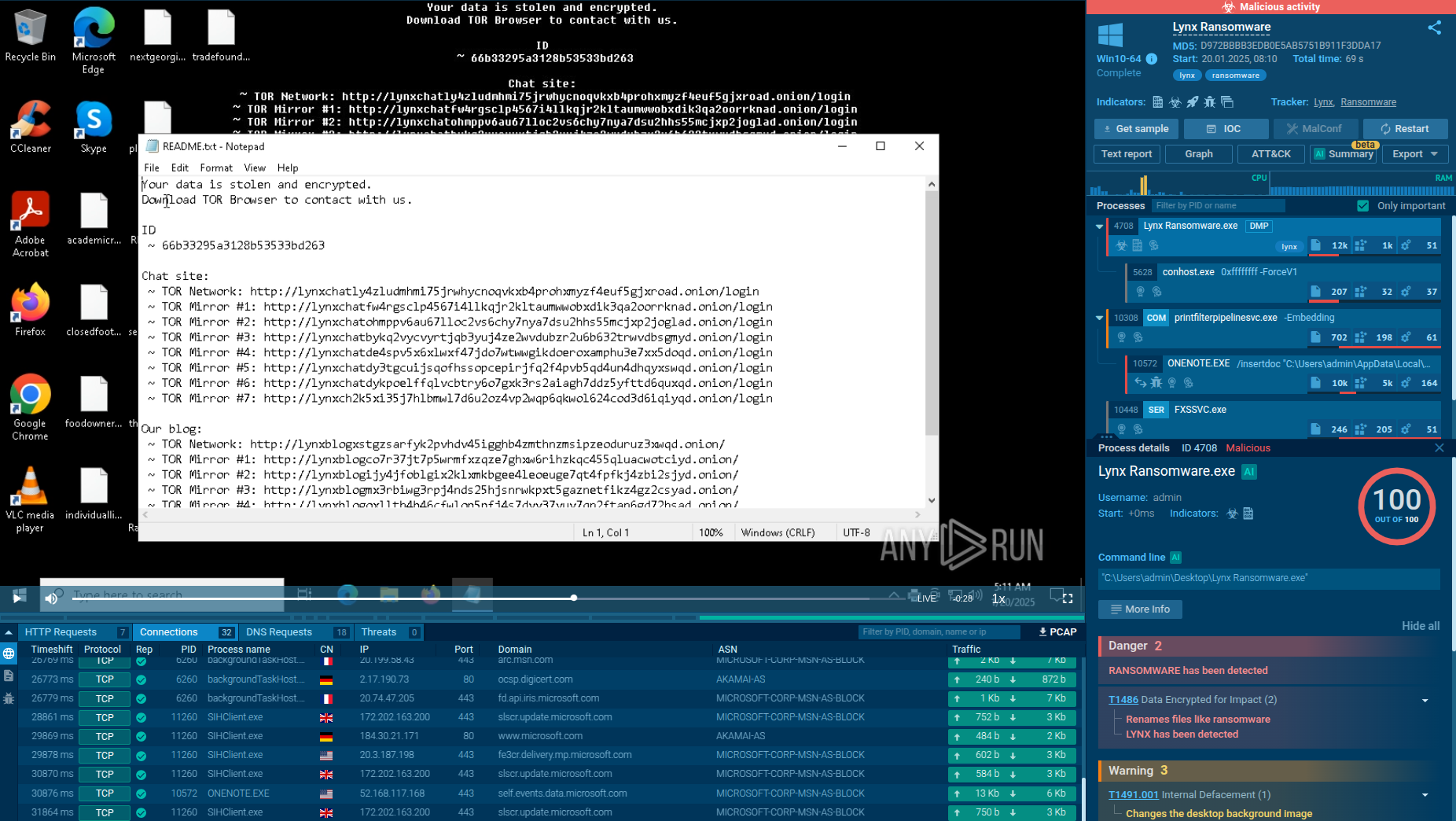
Distributed via targeted pishing email campaigns, software vulnerabilities, infected ads and websites, it evades detection and analysis by a number of techniques. Lynx is customizable and can deliver additional payload.
Lynx malware technical details
- By default, aims to encrypt all the files in the infected system including network shares and drives. Customized as RaaS, can focus on specific folders or file types.
- Sensitive data gets exfiltrated via encrypted channels, such as HTTPS or custom protocols. Besides files, Lynx can steal credentials and screenshots.
- Deletes shadow copies used to restore data.
- Attempts to kill system processes and services using methods like the RestartManager. Specifically targets services that prevent encryption and facilitate backup.
- Exploits vulnerabilities to escalate privileges within the targeted system.
- Maintains communication with a C2 server, uses domain generation algorithms (DGA) to ensure reliable connections.
- Can deliver malware payload, such as ransomware or wipers, or act as a backdoor for subsequent attacks.
- Employs a number of advanced evasion mechanisms: code obfuscation, polymorphism, using stolen credentials to access system entities. -Detects VMs, sandboxes, delays execution or modifies behavior to avoid analysis tools.
- Operates in-memory without writing files to the disk, reducing the chance of detection.
Lynx execution process
Lynx ransomware is a sophisticated malware variant renowned for its aggressive tactics and operational efficiency. Thanks to ANY.RUN's Interactive Sandbox, we can observe the malware's entire execution chain in a safe virtual environment.
Upon launching, Lynx parses any command-line arguments that dictate its behavior; if no arguments are provided, it defaults to encrypting all files on the system.
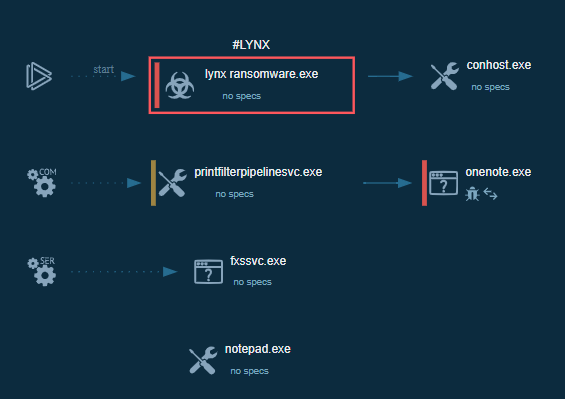
One of Lynx’s first actions is to terminate processes that could interfere with the encryption. It specifically targets backup and database-related applications — such as SQL, Veeam, Backup, Exchange, Java, and even Notepad — and iterates through these on its target list to stop them.
With potential obstacles removed, Lynx enumerates directories to identify files for encryption. To broaden its reach, it can mount hidden drives and network shares. It also hinders recovery efforts by deleting shadow copies and backup partitions, making it significantly more difficult for victims to restore data without paying the ransom.
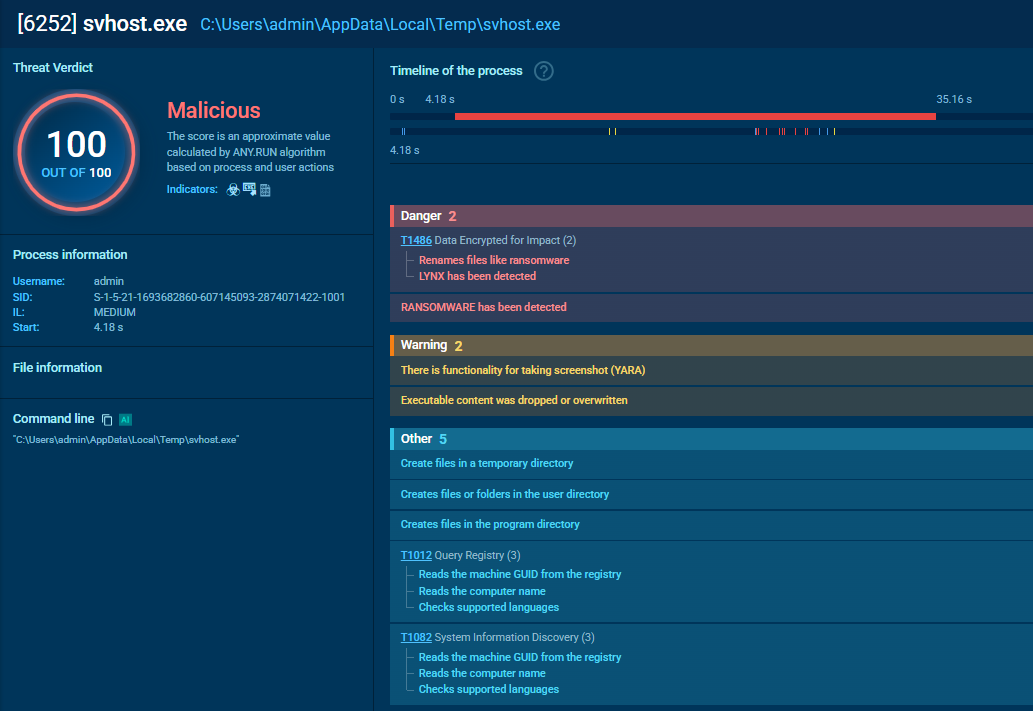
The malware uses robust encryption techniques, generating unique keys for each file, and appends the .lynx extension to all encrypted files. It can encrypt mounted drives, shared folders, and specified network resources.
After the encryption phase, Lynx delivers a ransom note on the victim’s desktop by changing the wallpaper, dropping a text file containing the ransom note, and placing an XPS file with the same message. This note typically provides a link to a dark web portal for paying the ransom and communicating with the attackers. Furthermore, Lynx employs “double extortion,” threatening to leak sensitive data if the ransom is not paid. This tactic amplifies pressure on victims, making Lynx a particularly formidable threat.
Collect Cyber Threat Intelligence on Lynx
Use Threat Intelligence Lookup from ANY.RUN to study IOCs and TTPs associated with Lynx and enforce your security framework against it. Search within a database of millions of malware analyses done in the ANY.RUN sandbox.
With over 40 customizable search parameters, including IPs, domains, file names, and process artifacts, you can gather relevant data for further proactive measures.
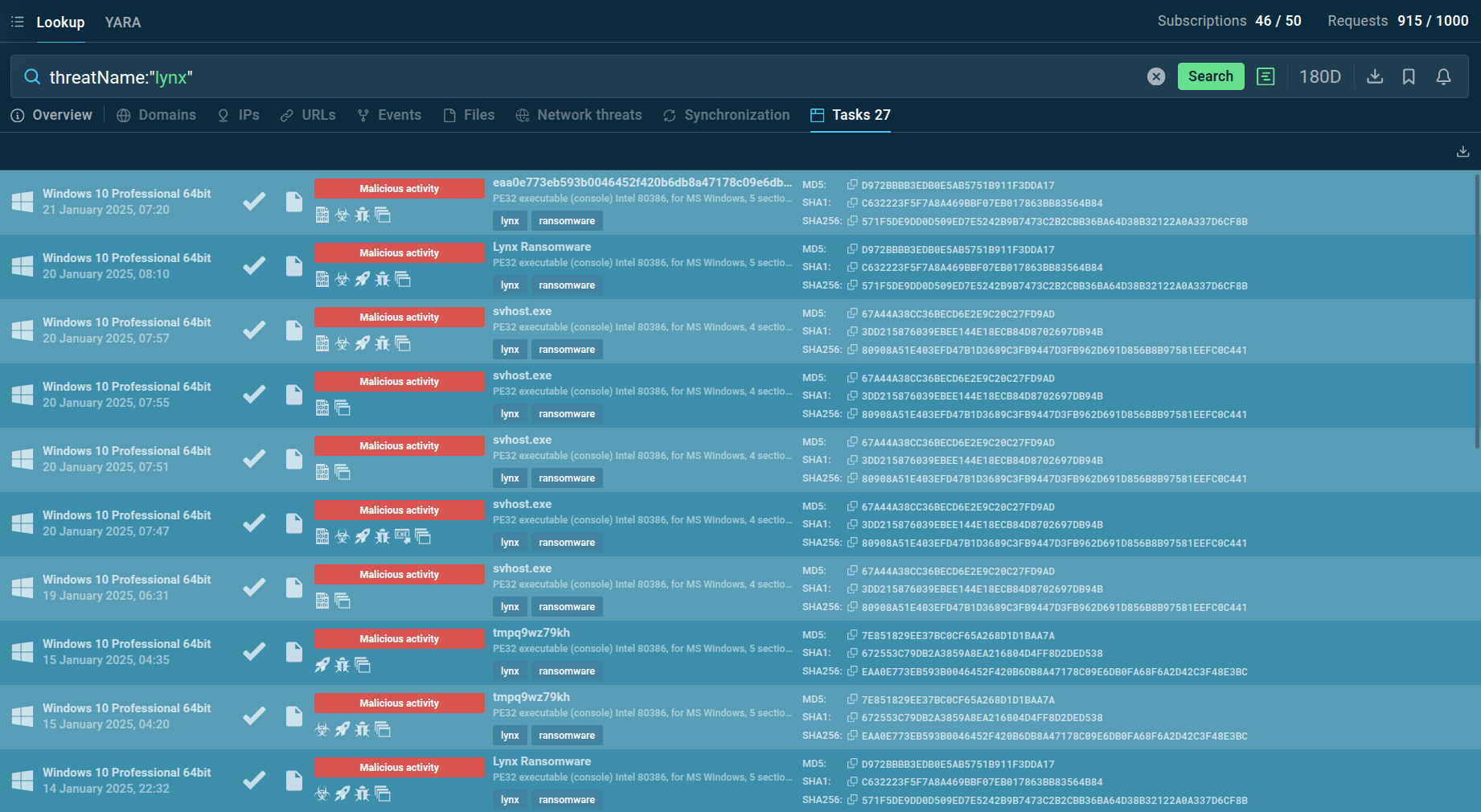
You can search directly by the threat name or use related clues like hash values or network connections. By entering a query like threatName:"lynx", you'll get a list of sandbox reports featuring the most recent analyses of Lynx samples. You can navigate to each report and explore it in detail to understand the malware's behavior and collect crucial threat intelligence.
Lynx malware distribution methods
- Spear-phishing email campaigns. Emails are crafted to appear legitimate and typically contain malicious attachments (e.g., Word documents, PDFs) or links to compromised websites.
- Exploiting vulnerabilities in unpatched software (operating systems, browsers, other applications), in popular document formats (e.g., macros in Microsoft Office files).
- Malvertising: code embedded in malicious ads on legitimate websites redirects victims to exploit kits.
- Supply Chain Attacks: compromises third-party software or libraries, distributing itself as part of trusted applications.
Conclusion
Lynx is a highly dangerous piece of ransomware aimed both at encrypting data and stealing it to do the most damage to the victim’s operations and reputation.
By default, Lynx is set to encrypt every file on the system. But as a RaaS, it is customizable via command-line arguments to precisely select files and directories to target.
It exploits various entry points into targeted networks and uses a number of anti-malware evasion techniques. Nevertheless, sophisticated tools like ANY.RUN’s Interactive Sandbox and Threat Intelligence Lookup successfully withstand Lynx’s defenses and allow security teams to study its behavior, get ready to detect it and protect against it.
Sign up for a free ANY.RUN account to strengthen your security posture!
Other malware & phishing threats
 Sneaky 2FASneaky 2FA is an Adversary-in-the-Middle (AiTM) phishing kit targeting Microsoft 365 accounts. Distributed as a Phishing-as-a-Service (PhaaS) through a Telegram bot, this malware bypasses two-factor authentication (2FA) to steal credentials and session cookies, posing a significant threat to individuals and organizations.
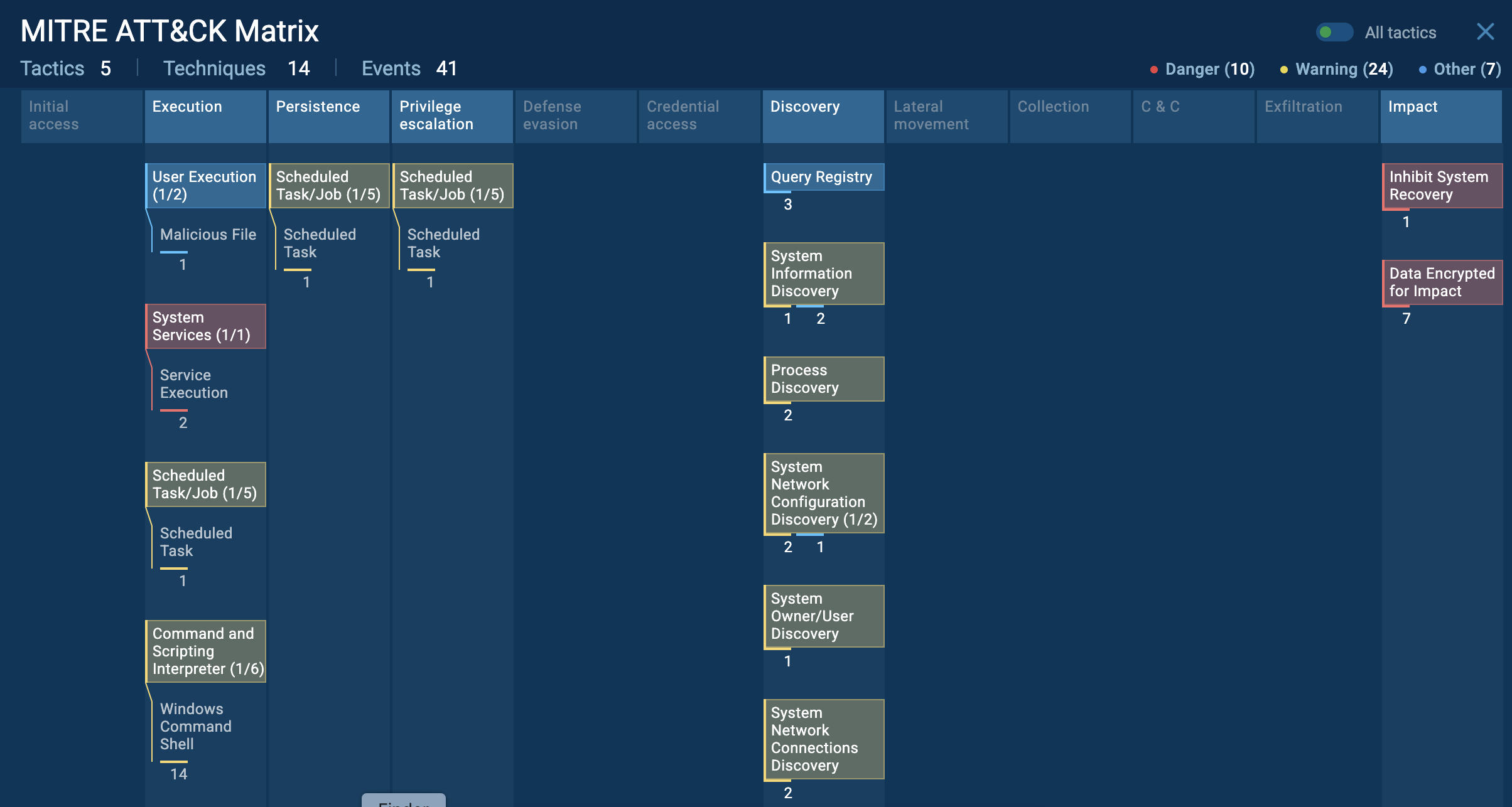 Fog RansomwareFog is a ransomware strain that locks and steals sensitive information both on Windows and Linux endpoints. The medial ransom demand is $220,000. The medial payment is $100,000.
First spotted in the spring of 2024, it was used to attack educational organizations in the USA, later expanding on other sectors and countries. Main distribution method — compromised VPN credentials.
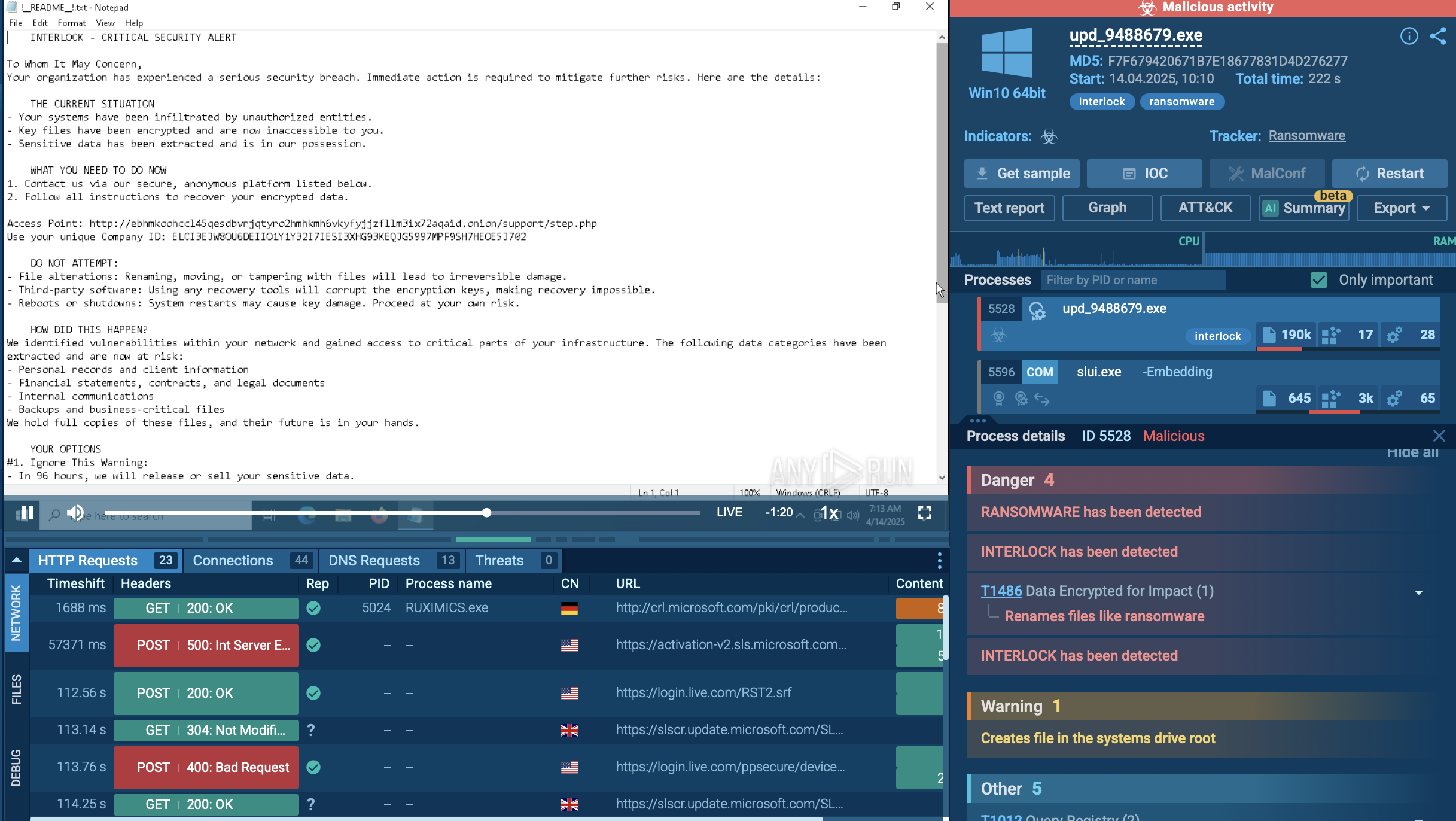 InterlockInterlock is a relatively recent entrant into the ransomware landscape. First identified in 2023, it's a multi-functional malware strain used in ransomware-as-a-service (RaaS) operations.
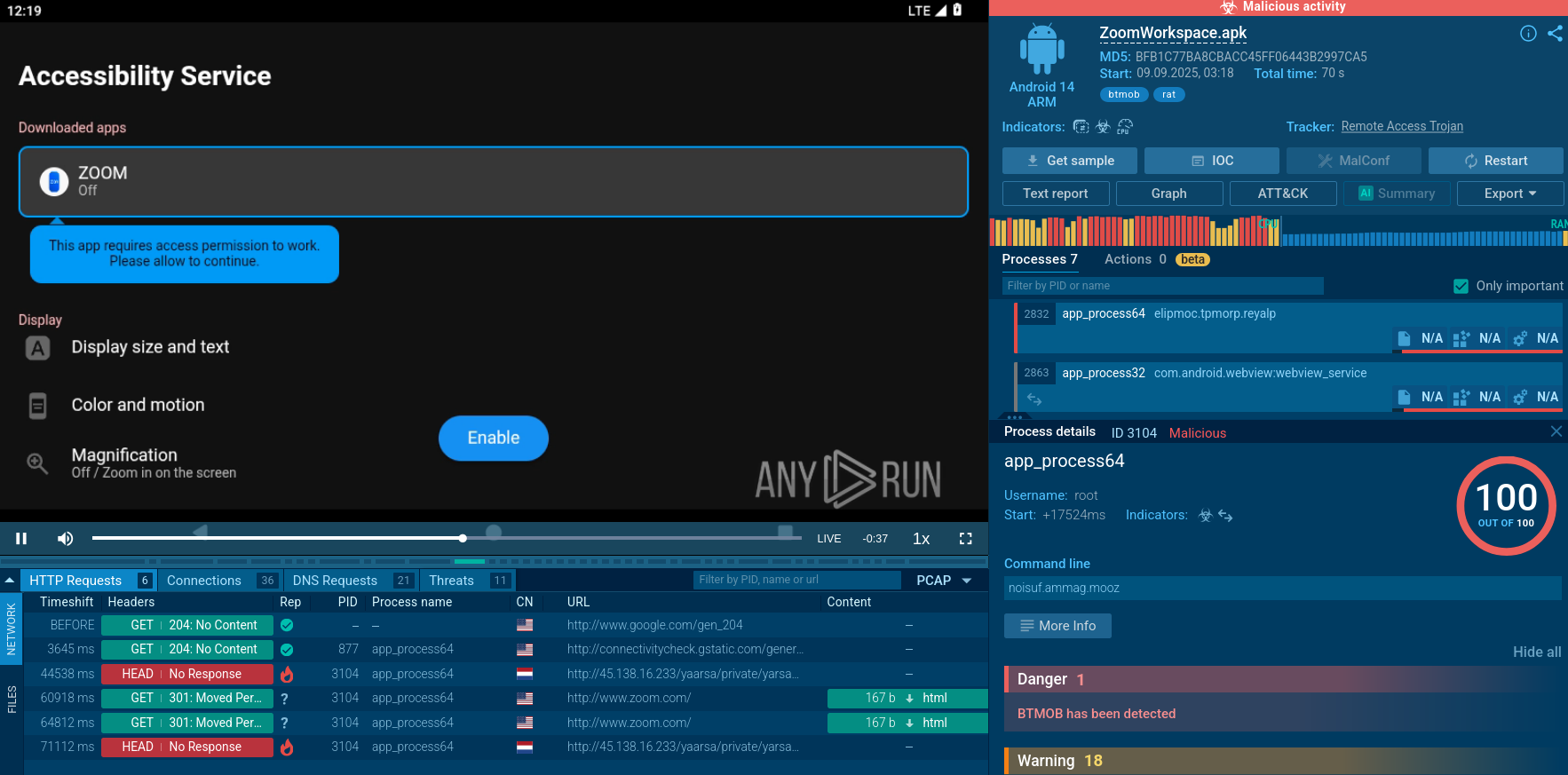 BTMOB RATBTMOB RAT is a remote access Trojan (RAT) designed to give attackers full control over infected devices. It targets Windows and Android endpoints. Its modular structure allows operators to tailor capabilities, making it suitable for espionage, credential theft, financial fraud, and establishing long-term footholds in corporate networks.
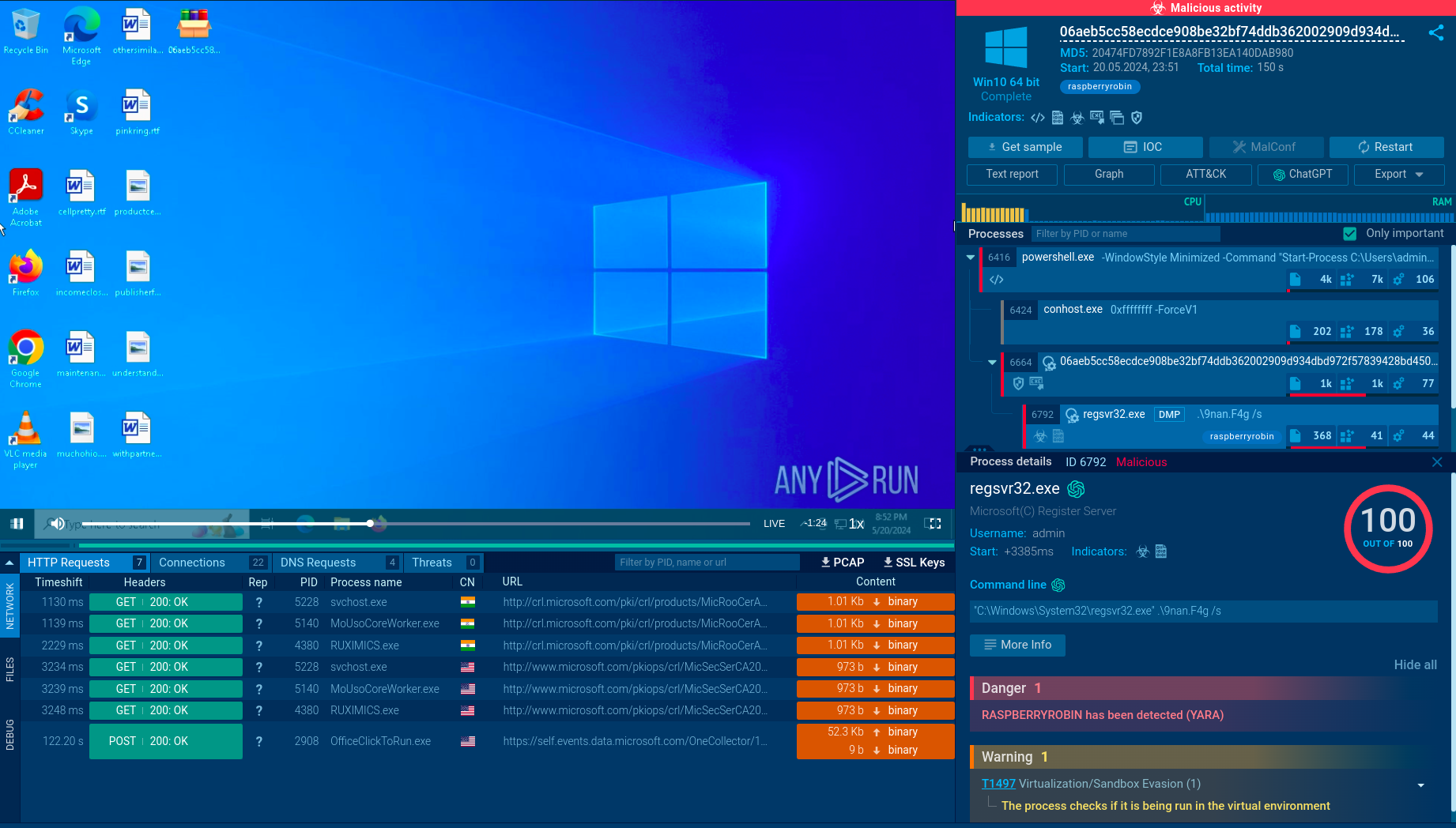 Raspberry RobinRaspberry Robin is a trojan that primarily spreads through infected USB drives and exploits legitimate Windows commands. This malware is known for its advanced obfuscation techniques, anti-debugging mechanisms, and ability to gain persistence on infected systems. Raspberry Robin often communicates with command-and-control servers over the TOR network and can download additional malicious payloads.
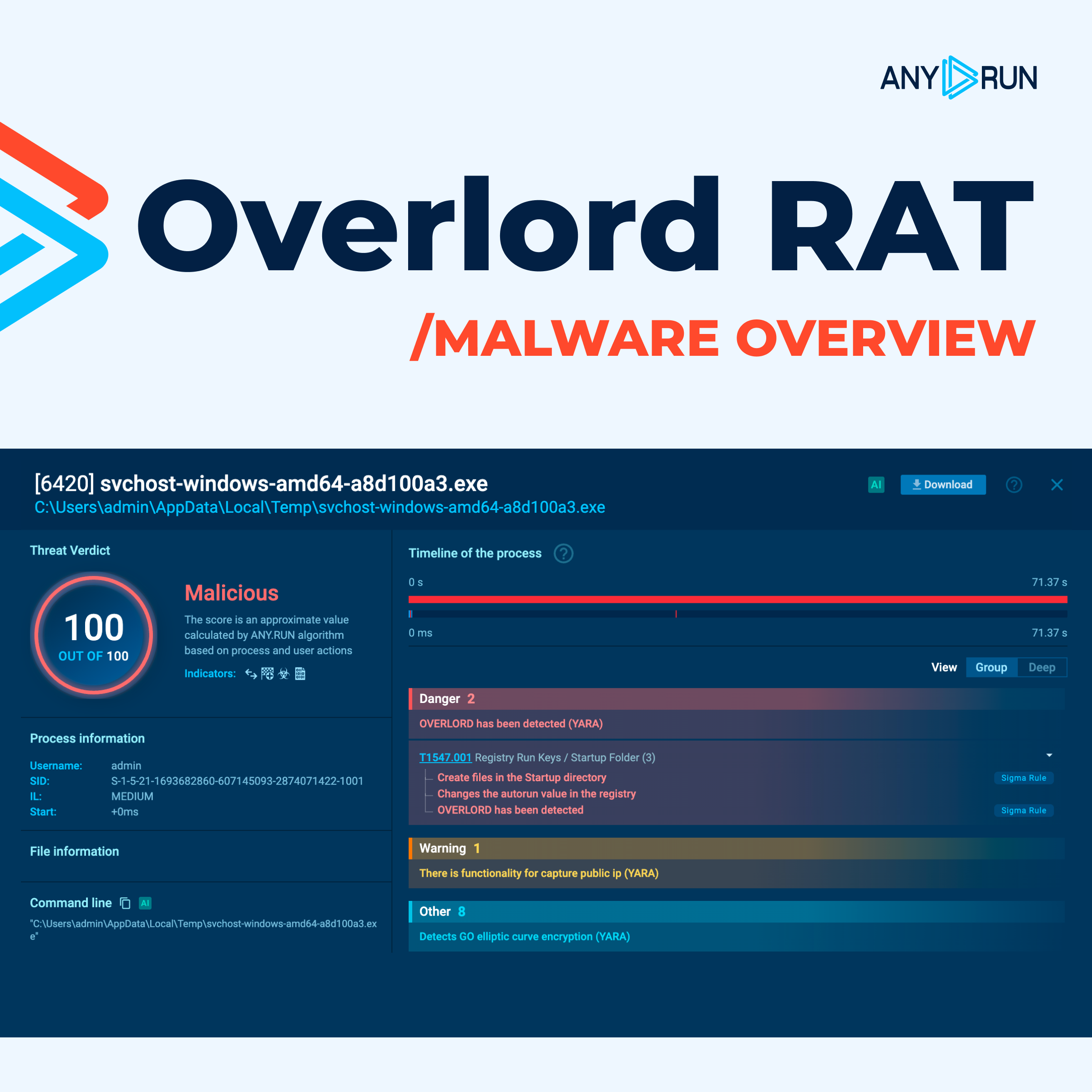 Overlord RATOverlord RAT is a cross-platform remote access framework with Go-based agents and a TypeScript/Node/Bun server. It supports encrypted WebSocket C2, remote control, persistence, and multiple operating systems, including Windows, Linux, and macOS.